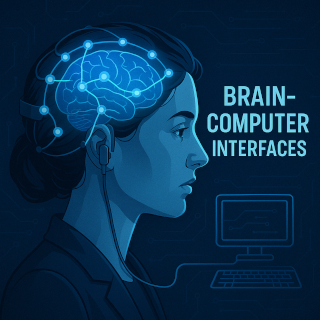
The Future is Now: How Brain-Computer Interfaces Are Blurring the Line Between Mind and Machine
Imagine sending a text message just by thinking about it. Or controlling a drone with nothing but your thoughts. It sounds like science fiction — but thanks to brain-computer interfaces (BCIs), this future is closer than you think.
What Are Brain-Computer Interfaces?
A brain-computer interface (BCI) is a technology that allows direct communication between the brain and an external device. Instead of using your hands to type, swipe, or click, BCIs let your brain bypass traditional physical inputs and connect straight to the machine.
At the core of a BCI is the ability to read neural signals — tiny electrical impulses that our brains generate all the time. These signals can be captured using sensors placed on the scalp (non-invasive) or, in more advanced cases, through implanted electrodes (invasive). Once the signals are interpreted, they can be used to control software, prosthetics, or even entire machines.
The Amazing Things BCIs Can Do
BCIs are already making a real-world impact, especially in the field of healthcare. Here are a few powerful examples:
- Restoring Movement: For people with paralysis or spinal cord injuries, BCIs are helping restore the ability to move and interact with the world. By decoding brain signals, researchers have enabled individuals to control robotic limbs or even reanimate their own limbs using electrical stimulation.
- Helping the Voiceless Speak: BCIs can help those who have lost the ability to speak, such as patients with ALS, by turning thought patterns into digital text or synthesized speech.
- Enhancing Focus and Performance: Some consumer-grade BCIs are being used to train attention, improve meditation, or enhance cognitive performance by monitoring brain activity and giving feedback in real time.
- Gaming and Entertainment: Believe it or not, BCI-powered video games already exist. Players can control characters or actions through concentration, relaxation, or specific thought patterns.
The Role of AI and Machine Learning
BCIs wouldn’t be nearly as powerful without AI. Your brain doesn’t speak in binary — its language is complex and unique to each person. That’s where machine learning comes in. AI algorithms learn to recognize patterns in your brain signals and translate them into usable commands, becoming more accurate over time.
This fusion of AI and neuroscience is opening the door to increasingly sophisticated and personalized brain-computer systems.
Ethical and Privacy Concerns
As exciting as BCIs are, they also raise some important questions. Who owns your brain data? Could it be hacked or misused? What happens when your thoughts can be interpreted — or even influenced — by a machine?
Privacy, consent, and mental autonomy are becoming hot topics in the BCI space. Researchers and policymakers are working to build ethical frameworks that ensure this powerful technology is used responsibly and safely.
What’s Next for BCIs?
The next decade could be revolutionary for BCIs. Companies like Neuralink, Synchron, and Kernel are developing devices that aim to go beyond medical applications — envisioning a world where BCIs enhance memory, treat mental health disorders, or even allow direct brain-to-brain communication.
As the technology matures, we may see BCIs merge with augmented reality, smart home systems, and digital assistants — turning our minds into the ultimate remote controls.
Final Thoughts
Brain-computer interfaces are no longer just the stuff of sci-fi movies. They’re real, they’re evolving fast, and they’re set to transform everything from medicine to gaming to how we connect with each other. As long as we move forward with care, ethics, and inclusivity, the age of mind-machine fusion could be one of the most profound shifts in human history.
What would you do if you could control a computer with your thoughts? Let your imagination run wild — the future is literally all in your head.


Leave a Reply to Brenda899 Cancel reply